

Cibarious logo

SideNorthern Europe

Mashed Potatoes Recipe

Starch is the whole story: which potato, how hot, and why the blender ruins it.

4
servings
40
minutes
5
ingredients

Whole starch cells, riced hot and fed warm fat

6 min read · 1,219 words

Plate I · Ingredients
  1. Potato
  2. Butter
  3. Heavy Cream
  4. Salt
  5. Black Pepper
Curated by CibariousIllustrations byCibarious
4 portions

Ingredients

4 portions, 40 minutes, and the key moments that shape the result.

  • 900 gPotatopeeled, cut into even 4 cm (1½ in) chunks
  • 85 gButterunsalted, melted with the cream
  • 120 mlHeavy Creamwarmed until steaming, never boiling
  • 16 gSaltfine; about 12 g in the pot, 4 g at the end
  • 1 gBlack Pepperfreshly ground, at the end

What runs when

Board
Pot
Saucepan

Method

  1. Peel and cut

    0′–8′

    Peel 900 g of potatoes and cut them into even chunks about 4 cm (1½ in) across. Drop them into the pot as you go.

    Why: Even chunks cook at the same pace. Smaller pieces absorb too much water, while bigger ones are still hard in the middle when the outside is soft. Read more

  2. Cold water, salt, heat

    8′–16′

    Cover the potatoes with cold water by about 3 cm and stir in 2 tsp (12 g) of fine salt. Set the pot over high heat, uncovered, until it just comes to a boil.

    Why: Starting cold heats the potatoes through from the outside in. Boiling water cooks the outside to mush before the center is ready. Salt seasons them all the way through. Read more

  3. Simmer until tender

    16′–31′

    Turn the heat down to a gentle simmer. Cook 15 minutes, until a paring knife slides into the middle of a chunk with no resistance and the chunks start to crack at the edges.

    Why: A hard boil bangs the potatoes around and breaks the surface. Fully tender potatoes mash easily and take far less force. Read more

  4. Warm the butter and cream

    24′–29′

    In a small saucepan, melt 85 g (6 tbsp) butter with 120 ml (½ cup) cream over low heat. Heat until steaming and about 70 °C (160 °F), then take it off the heat. Do not boil.

    Why: Hot dairy keeps the mash hot and slides into the starch. Cold cream cools the mash and leaves butter in chunks, and pushes you to stir longer. Read more

  5. Drain and dry

    31′–34′

    Drain the potatoes in a colander for a minute. Put them back in the dry pot over low heat for 1–2 minutes, shaking now and then, until the steam stops and a floury film forms on the bottom.

    Why: Wet potatoes make wet mash. Steaming off the surface water also leaves the starch ready to take up fat and cream. Read more

  6. Rice it hot

    34′–36′

    While the potatoes are still steaming hot, press them through a ricer or food mill back into the warm pot, in two batches. No ricer: use a hand masher with firm, straight-down presses, not stirring.

    Why: Pushing hot cooked potato through holes separates the cells without bursting them. Stirring, beating or blending tears them open and releases sticky starch. Read more

  7. Fold in the dairy

    36′–38′

    Pour in half the warm butter and cream. Fold with a wooden spoon in slow, wide strokes just until it vanishes, then add the rest. Stop as soon as the mash looks even.

    Why: Each stroke you take at this stage presses more starch out of the cells. Folding spreads the fat without much force. Read more

  8. Season and serve

    38′–40′

    Taste. Add the last ¾ tsp (4 g) of salt, a small pinch at a time, and a few cranks of black pepper. Serve at once from the warm pot.

    Why: Mash cools and stiffens quickly, and salt tastes stronger on hot food. Adjust it now, in the moment you will eat it. Read more

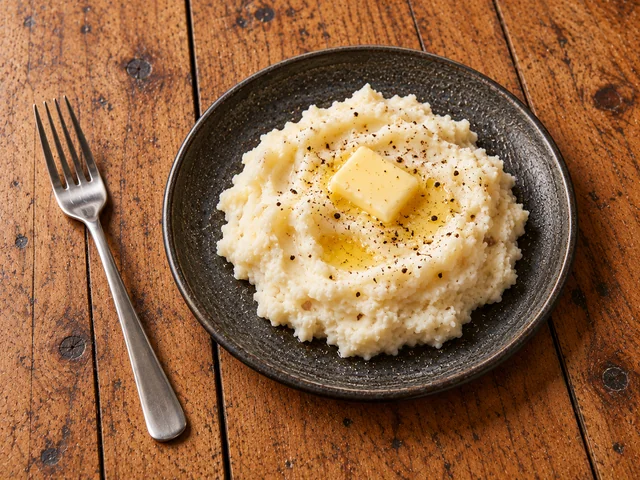
Mashed Potatoes, finished and plated
Plate II · The finished dish

Why It Works This Way

You have the recipe. Here's why it works, and what happens when you change it.

The Mash

Mashed potatoes are rarely ruined by the potato. They are ruined in the two minutes after the water goes down the sink.

Raw potato starch is packed into granules inside cells. Cooking swells the granules and softens the glue holding the cells together. Done gently, the cells part and stay whole, and that is a fluffy mash. Done hard, the cells tear, and the starch they spill out forms a sticky gel.

Heat matters as much as force. Hot potatoes fall apart with almost no effort. As they cool, the starch stiffens and the cells grip each other again, so you press harder and break more of them. That is why a ricer, a food mill, and speed are the three rules of a smooth mash.

A blender, a food processor or a long spell with a hand mixer shears the cells at high speed. The result is not mash but an elastic paste, closer to dough than anything you want next to a roast. Waxy potatoes get there faster, because their cells cling more tightly.

Right
Light and soft, falling off the spoon in mounds, with a few small lumps if you hand-mashed. Season and serve.
Too loose
Slack and wet, usually from undried potatoes or cold dairy added all at once. Stir over low heat for a minute to drive off the water, then eat it.
Too far
Shiny, stretchy and sticky like dough: the starch is out of its cells and nothing will put it back, so thin it into soup or fry it as potato cakes.

Rules You Can Break

Common changes, and what each one actually does to the dish.

  • Blender or food processorDon't

    The blades tear open the cells and turn the mash into glue within seconds. A ricer, a food mill or even a hand masher is far better.

  • Cold butter and creamChanges the dish

    Cold dairy cools the mash and takes longer to blend in, so you stir more. Melting and warming them first takes a few minutes and costs nothing.

  • Dropping into boiling waterChanges the dish

    The outside overcooks and sloughs off before the center is done. Start in cold water, bring it up together, and keep the simmer gentle.

  • Leaving the skins onHarmless

    Yukon Gold skins are thin and tasty. You get a rustic, speckled mash and lose some smoothness, so skip the ricer and use a masher.

  • Milk instead of creamHarmless

    Lighter and a little less rich, which many people prefer. Use about 50% more milk than cream and keep it warm.

  • Sour cream or cream cheeseChanges the dish

    Adds tang and a denser, more stable texture that holds well on a buffet. It is a different dish, not a better version of this one.

  • More cream to fix gluey mashHides the technique

    Loosens the paste so it pours, but not the texture. Gluey mash with extra cream is still gluey, just wetter.

A Slow Arrival

Potatoes reached Spain from the Andes in the second half of the sixteenth century, and Europe took its time to trust them. In the north they spread slowly and were widely eaten once grain harvests failed. Boiling and crushing them with fat was the simplest way to make them filling.

Hannah Glasse's The Art of Cookery Made Plain and Easy, published in England in 1747, includes one of the earliest printed recipes for mashed potatoes, with milk and butter. Similar dishes are old across the region: stamppot in the Netherlands, colcannon and champ in Ireland, Kartoffelbrei in Germany.

What Each Ingredient Does

  1. PotatoThe starchProvides all of the body. Each cooked cell holds swollen starch granules that stay put if you are gentle and turn to glue if you tear them open. The variety decides how forgiving that is.
  2. ButterThe richnessCoats starch granules in fat, so they slide past each other instead of sticking, and adds flavor. Added warm, it melts in. Added cold, it sits in the mash as slow-to-melt chunks.
  3. Heavy CreamThe silkAdds water to loosen the mash and fat to keep it smooth. At 36% fat it makes a creamy texture without thinning out the way milk does.
  4. SaltThe seasoningPotatoes are bland and starch mutes flavor. Salt in the water seasons the flesh all the way through, and a second pinch at the end corrects what is left.
  5. Black PepperThe warmthAdds a bit of heat and aroma that cuts through the cream. Added at the end, its volatile oils are still fresh.

Even gastronauts make mistakes sometimes! Always check mission-critical intel like allergens and substitutions. See our Terms of Use & Editorial Policy.

Now Send This Recipe Down the Line

Good cooks don't guess. They share, too!

Help another home chef make this dish work.

More Recipes to Love

all recipes
1 / 3

Primo · Rome, Lazio

Spaghetti alla Carbonara

Five ingredients, no cream, one critical minute. The recipe comes first; everything that makes it work comes after.

2 servings · 25 min

Main · Bangkok, Thailand

Pad Kaphrao

Holy basil, bird's eye chili, a smoking wok and a fried egg on top: Bangkok's lunch, taken apart.

2 servings · 20 min

Baking · United States

Vanilla Muffins

Two bowls, a lazy fold and the reason overmixing leaves tunnels in the crumb.

12 servings · 35 min

Starter · Southern Vietnam

Spring Rolls

A thin wrapper, a dry filling and oil at the right heat: the three rules of the crackle.

6 servings · 50 min

Filed Under