
7 min read · 1,465 words
I was on the phone with my sister in Oaxaca last week, and she was mid-crisis. Not a real crisis, a kitchen crisis, which in our family is treated with the same seriousness. She was making sopa seca for a birthday dinner, the one with the thin noodles toasted in a guajillo sauce, and she’d run out of the proper fideo. “Can I use the orzo?” she asked, her voice a mix of panic and hope. I told her no, absolutely not, the texture would be all wrong, it would drink the broth differently. But then I heard the rustle of her pantry shelf. “What about… arborio?” And I paused. Because that’s the moment you realize your pantry isn’t just a collection of things. It’s a network of possibilities and dead ends. You don’t need one of every rice in the world. You need the right few, the ones that speak to each other, that cover for each other on a Tuesday night when the fideo is gone.
That’s what a sensible rice collection is about. It’s not about hoarding exotic varieties to impress someone (who are you trying to impress, your cat?). It’s about having the structural players that let you build a meal from the shelves up. My own collection lives in glass jars on a dark, cool shelf: five types, max. Any more and you’re running a grain library, not a kitchen. Let’s talk about the ones that earn their spot, the ones that do the heavy lifting so you can stop staring into the abyss of the international aisle and just cook.
Long-Grain White (like Basmati or Jasmine)
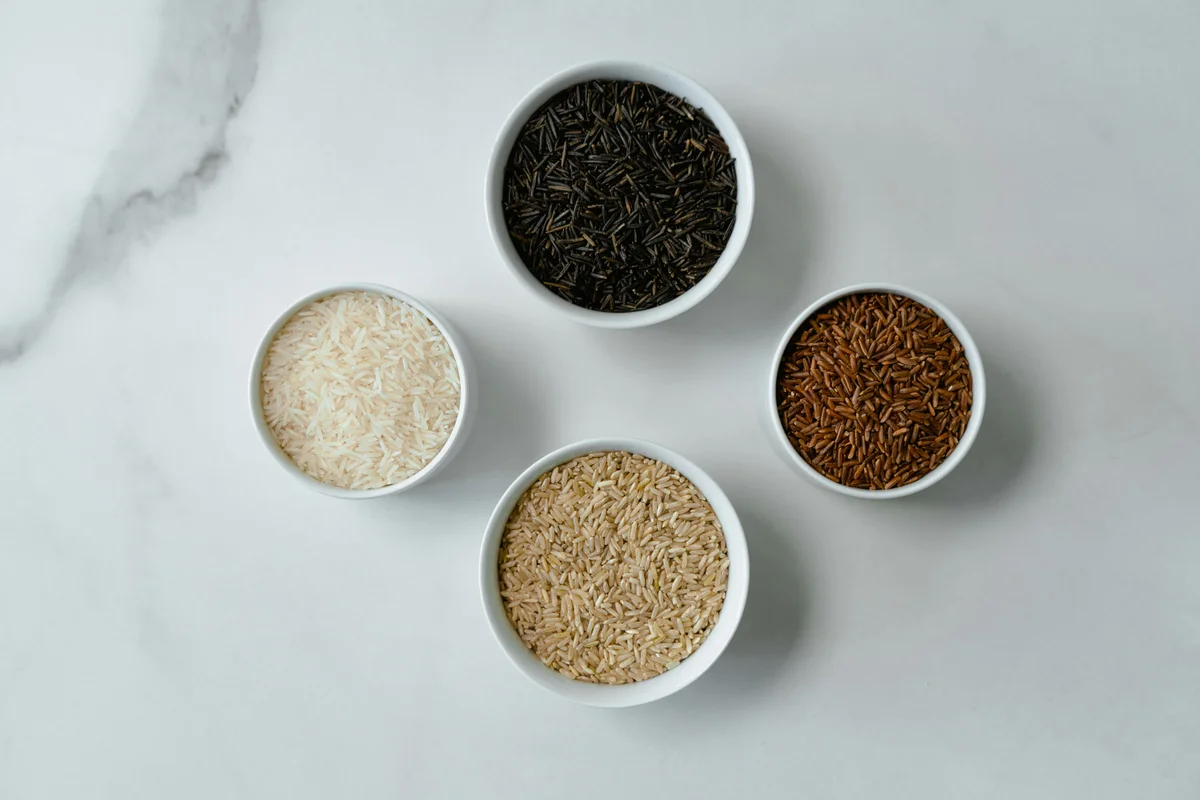
Basmati is the elegant one. Grown in the foothills of the Himalayas, it should smell floral, almost like popcorn flowers when you rub a few grains between your palms. The grains should be long and slender, and they cook up dry, separate, and perfumed. This is your rice for biryani, for pilafs where every grain needs to stand apart, for serving under a rich curry where it won’t turn to mush. It’s a rice that demands respect: always rinse it until the water runs clear to get rid of excess starch, and I often soak mine for 20 minutes. It’s not fussy, it’s just proper.
You don’t need one of every rice in the world. You need the right few, the ones that speak to each other.
Jasmine rice, from Thailand, is the other side of the coin. It’s clingier, softer, with a subtle pandan-like fragrance that’s more buttery than floral. It’s what you want for Thai food, yes, but also for any meal where you want the rice to be a comforting, slightly cohesive bed. It’s more forgiving than Basmati. The trade-off is in the texture: Jasmine gives you tenderness, Basmati gives you architecture. You don’t need both, but you should choose one with intention. I keep a good Basmati because its distinct character holds up to my more boldly seasoned dishes. A producer once told me the aging process for true Basmati is crucial: new crop Basmati can be brittle. I want the one that’s been rested, like a good piece of meat.
Italian Short-Grain (Arborio, Carnaroli, Vialone Nano)
Okay, let’s go to Rome. My Pietro will tell you the only rice for risotto is Carnaroli, the “king of rices.” And he’s not wrong. But my suocera, in her tiny kitchen in Trastevere, often reaches for Vialone Nano for her risi e bisi (rice and peas). And me? I usually have Arborio on my shelf. Why? Because this isn’t about royal decrees. It’s about practical magic.
All these rices are short, fat, and high in starch. That starch is what gets slowly coaxed out by stirring and hot broth, creating risotto’s creamy sauce without any cream. The difference is in the starch composition and the grain’s core. Carnaroli has a firmer core, so it’s more forgiving: it’s harder to overcook. Vialone Nano absorbs flavors incredibly quickly and is brilliant for soupler, brothier dishes. Arborio releases its starch a bit more readily, which can actually be an advantage when you want that luxuriously creamy texture fast.
I stock Arborio because it’s the most widely available quality short-grain, and I understand its behavior. I know that with a good Parmigiano-Reggiano (the 24-month one, grated at the very end) and a patient hand with the warm broth, I can get the ondata, the creamy wave, I want. The actionable insight? Whichever you buy, do not rinse it. You’re washing away the very starch you need. And toast the rice in your fat (butter, olive oil, pancetta drippings) until it’s translucent around the edges before you add your wine. That seals the grain. This rice is about technique as much as the ingredient itself.
Medium-Grain (like Calrose or “Sushi” Rice)
This is the rice of my other home, the one that bridges continents in my kitchen. Often labeled “sushi rice” or simply “medium-grain,” varieties like Calrose are what you find in Japanese, Korean, and many Chinese households. When cooked, it’s stickier than long-grain but firmer than the mush that bad cafeteria rice promises. It has a gentle sweetness and a glorious, tender chew.
I use this for more than sushi. It’s my go-to for rice bowls, because it holds together nicely when you pick it up with chopsticks. It’s perfect for onigiri, those stuffed rice balls my kids love. And it’s the only rice I’ll use for arroz con leche, the Mexican rice pudding. Why? Because its starchiness creates the perfect creamy-yet-defined texture, each grain still distinct in the cinnamon-infused milk. Long-grain rice in arroz con leche always feels wrong to me: too separate, not comforting enough.
Learn the behavior of the rice you invite into your kitchen. Know how it drinks water, how it takes to fat, whether it likes to be left alone or stirred constantly.
The key here is the wash and the soak. You rinse it aggressively, swirling with your hand until the water goes from cloudy to almost clear. Then you let it soak in its cooking water for at least 30 minutes before you even turn on the heat. This allows for perfectly even cooking from the core out. It’s a lesson in patience that pays off in every glossy, perfect grain.
Heirloom or Pigmented Rice (like Red Rice or Black Forbidden Rice)
This is your one “special” rice. You don’t need five. You need one that brings something dramatic and nutritious to the table, literally. I keep a black Japonica rice or a Thai Red cargo rice. These are whole-grain rices, meaning the bran is left on. That means they’re nuttier, chewier, and take longer to cook: sometimes 45 minutes to an hour.
I don’t use these as a main pile of rice. I use them as a mix-in. I’ll cook a pot of black rice and then fold a cup of it into my white Jasmine rice for a stunning, textural, nutrient-packed side. I’ll use red rice as a base for a hearty grain salad with roasted squash, pepitas, and a bright lime-cumin vinaigrette. They add depth, color, and a feeling that you’re eating something substantial. They’re also brilliant in stuffings or as a bed for a seared piece of fish. They shout “I meant to do that” without you having to build a whole meal around them.
A word of warning: the “forbidden” or black rices will turn everything purple. Your pot, your utensils, your other rice if you mix it. It’s a beautiful, deep amethyst color, but know it’s coming. It’s not a flaw. It’s a feature. Just don’t use your best white linen napkins.
So that’s the collection: the architectural long-grain, the creamy short-grain, the clingy medium-grain, and the dramatic wild card. Four, maybe five jars. They each have a job. They cover for each other in a pinch (no, you can’t make risotto with Basmati, but in a true emergency, that medium-grain will give you a creamy-ish result if you baby it). This isn’t about authenticity locked in amber. It’s about building a pantry that works as hard as you do.
The last perspective? It comes from my abuela, though she never said it outright. She’d look at my neatly labeled jars and smile. To her, rice was just arroz. But she knew which pot to use for which occasion. The real takeaway is to learn the behavior of the rice you invite into your kitchen. Know how it drinks water, how it takes to fat, whether it likes to be left alone or stirred constantly. Once you know that, you’re not following a recipe line for line; you’re conducting. And you can always, always get dinner on the table. Even when the fideo runs out.