
9 min read · 1,698 words
I was standing in a Rimi in Riga, in the international aisle, watching a man have a quiet crisis. He was holding a bag of rigatoni in one hand and a jar of ragù alla bolognese in the other. He’d put the jar down, pick up a box of spaghetti, stare into the middle distance for a second, then swap back. This went on for a solid three minutes. He wasn’t reading labels; he was trying to solve a puzzle he didn’t have the instructions for. I wanted to tap him on the shoulder and say, “The rigatoni. Always the rigatoni with that sauce. The spaghetti is for the cacio e pepe you’ll never find pecorino for here, but we can talk about that later.” But you don’t do that in Latvian supermarkets. You just watch the chaos unfold, and make a mental note for the taxonomy.
That man wasn’t choosing pasta. He was trying to intuit a fundamental law of the edible universe: the relationship between form and function, between groove and gravy, between the architecture of wheat and the physics of cling. We get so hung up on the what, is it bronze-drawn? Is it from Gragnano?, that we forget the why. Why does this shape exist? What problem was a nonna in Puglia or a pastificio in Napoli trying to solve when she twisted that dough into a strozzapreti or they extruded it into a calamarata?
The answer isn’t in regional pride, though that’s part of the story. It’s in applied engineering. Every pasta shape is a tool, designed with intent. And choosing the right one isn’t about authenticity police. It’s about respecting the work of both the pasta maker and the sauce maker. It’s about making sure no one at the table, sauce, pasta, eater, feels neglected.
My grandmother in Salerno, she didn’t have a pasta chart. She had a system, wired so deep into her cerebellum it might as well have been the part that regulated her heartbeat. Tuesday’s leftover brodo became Wednesday’s pastina, the tiny stars and alphabets that floated in the clear broth, their job purely to be carried by the spoon, a vehicle for warmth. Thursday’s ragù, which had simmered since dawn, demanded a serious partner. It got the ziti, the long, hollow tubes she’d break by hand over the pot with a dry, satisfying snap that sounded like a promise. The sauce would flood the interior, and a little would get caught in the rough, floury exterior from her hands. Every bite was a composite.
She was, without knowing the term, a master of surface area management. This is the first law of pasta logic. It’s not just about size. It’s about texture and topology. A smooth, round spaghetto has a relatively modest surface area. Its job is to be lightly coated, to let a slick, emulsified sauce like aglio, olio e peperoncino or a simple fresh tomato sugo slide along its length. It’s a dancer, not a sponge.
Now, take a rigatoni. Look at it. Really look. It’s a fortress. It’s got length, girth, a hollow center (the lumen, if we’re being taxonomical), and those deep, exterior ridges (rigati). Its surface area is enormous. It’s built for siege warfare against chunky, robust sauces. The ridges act as catchment basins for chunks of meat, peas, cubes of pancetta. The sauce doesn’t just coat; it lodges. The hollow center gets plugged at one end with a piece of meat, creating a flavor bomb that explodes when you bite. Using a smooth pasta for a chunky sauce is a tragedy of separation: the sauce falls to the bottom of the bowl, the pasta sits naked and ashamed on top. It’s a bad marriage.
We get so hung up on the what, - Is it bronze-drawn? Is it from Gragnano?, - that we forget the why. Why does this shape exist?
I learned this the hard way, far from home. In Prague, in a fit of homesickness, I tried to make a proper amatriciana with guanciale I’d cured myself and the only pasta I could find: smooth, flimsy spaghetti. The result was a greasy, disconnected mess. The fat rendered from the guanciale couldn’t cling; the tomato coated nothing. It tasted right, but it ate all wrong. The chaos of flavors never organized itself on the fork. I’d violated the law of surface area. The next week, I found a deli selling imported bucatini, the hollow spaghetti, and the world realigned. The sauce shot through the center, the roughness held the cheese. Order from chaos.
This leads us to the second principle: sauce viscosity and the mechanics of capture. Think of sauces on a spectrum from light, oily, and emulsified to thick, chunky, and clingy. Your pasta shape is the net you use to catch them.
For the light, slippery ones, your carbonara (in its true, guanciale-and-egg form), your cacio e pepe, your aglio e olio, you need a shape with enough texture to create friction. Spaghetti works if it’s good quality and rough from bronze extrusion. But tonnarelli or rigatoni? Even better. The coarse surface grabs the microscopic particles of cheese and pepper in the emulsion, building layers on the pasta itself. The sauce isn’t a separate entity. It’s a construction project on the pasta’s scaffolding.
Now, for the thick, rustic, vegetable-heavy sauces, your pesto Genovese, your broccoli e salsiccia, your ragù di cinghiale, you need a shape that can integrate, that becomes part of the landscape. Trofie, those little twisted Genoese gems, are literally designed to nestle into each other with bits of potato and green bean, trapping the pesto in their folds. Orecchiette, “little ears”, are perfect concave scoops for catching cime di rapa and anchovy. They’re not just pasta; they’re edible utensils.
Which brings me to my personal hill to die on, a piece of anti-gatekeeping that would make my Roman friends wince: the hollow pasta supremacy. Bucatini, maccheroni, ziti, calamarata, paccheri. These are the problem-solvers. A hollow shape does two things nothing else can. First, it creates an internal reservoir for liquid sauce. A well-made bucatini all’amatriciana should give you a slight, peppery squirt of sauce when you bite it. That’s not a flaw. It’s a feature. It’s the pasta participating in the sauce delivery system.
Second, and this is the systems-thinker in me geeking out, it changes the eating tempo. You bite a solid pasta, you get flavor from the outside in. You bite a hollow pasta filled with sauce, you get an immediate, concentrated burst from the inside, then the exterior coating. It’s a two-phase flavor experience. It’s narrative structure in dinner form: setup, then payoff, in every single bite.
You’re deciding how the conversation between wheat and tomato, between cheese and pork, will be conducted.
I tested this theory with a pot of ragù in my Riga kitchen, using the same sauce on spaghetti, rigatoni, and paccheri: those giant, wide tubes. The spaghetti was fine, polite. The rigatoni was excellent, hearty. The paccheri was an event. You could stuff one with a piece of meat, fold it over, eat it with your hands. It was immersive. It made you lean over the plate. It changed your posture. That’s when a shape stops being just a vehicle and becomes an environment.
But what about the delicate shapes? The farfalline, the ditalini, the stelline? Here’s where we move from engineering to psychology, to the principle of culinary context. These small, often soup-based pastas aren’t primarily about catching sauce. They’re about texture and comfort, about altering the body of a liquid. Pastina in brodo is a cure, a memory. The tiny shapes swell, thicken the broth slightly, make it more substantial. They’re there to be contained, not to contain. Using them in a thick sauce would be like using a teaspoon to eat a steak: the tool is mismatched to the task’s scale and intention.
This is where people, especially outside Italy, get tangled. They see pasta as a monolith. They’ll use penne for everything because it’s versatile, and it is. But versatile is another word for “compromise.” A penne rigate is a good all-rounder: it has ridges, it’s short, it’s hollow-ish. But it will never be the best at anything. It won’t cradle sauce like an orecchiette, it won’t deliver a liquid payload like a bucatini, it won’t elegantly carry a slick emulsion like a good linguine. It’s the reliable middle manager of the pasta world. And sometimes, you don’t want a manager. You want a specialist.
My five winters in the Baltics have added a coda to this logic: the principle of substitution. You will not find fresh trofie in Riga. You will find fusilli. And you know what? A fusillo, with its tight corkscrew, is a fantastic trap for pesto. It’s not authentic, but it’s logical. The logic of the shape, maximizing surface area, creating helical grooves for sauce to hide in, transcends the specific name. I’ve used Latvian pelēkie zirņi (grey peas) in a pasta e ceci instead of ceci neri, and the same rule applied: I chose a small ditalini so the peas and pasta could intermingle as equals in the broth. The ingredient changed, but the architectural reasoning held.
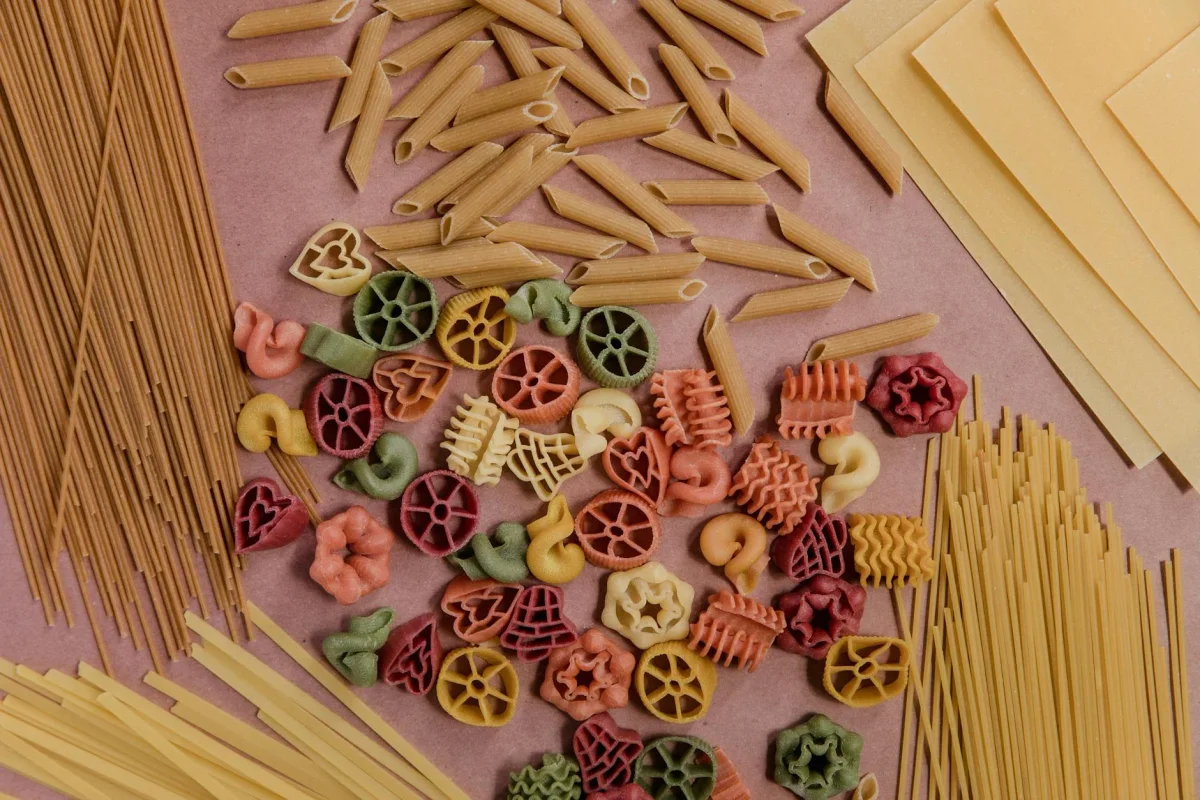
So, the next time you’re in the supermarket aisle, paralyzed, do this. Look at your sauce. Is it smooth or chunky? Is it oily or thick? Is it meant to coat or to be scooped? Then, look at the pasta. Is it smooth or rough? Is it solid or hollow? Is it a scoop, a tube, a twist, or a sheet? You’re not just picking a shape. You’re choosing the mechanism of cohesion. You’re deciding how the conversation between wheat and tomato, between cheese and pork, will be conducted.
Forget the rules about never breaking spaghetti. My grandmother broke ziti over the pot. The real crime isn’t breaking pasta. It’s breaking the logic. It’s leaving the sauce stranded at the bottom of the bowl, and the pasta lonely at the top. Your job is to be the chaos organizer for your dinner. To make the messy, beautiful world of flour and water and simmered things make sense, one perfectly sauced, intentional bite at a time. Start with the rigatoni. You can thank me later, when you’re wiping the ragù from your chin, and every component of your plate feels like it finally, properly, belongs together.