
9 min read · 1,835 words
The first time I saw a Latvian pelēkie zirņi (grey pea) dumpling, a pīrāgi, I felt a jolt of recognition so sharp it was almost vertigo. It was a half-moon, crimped shut with a braided edge, sitting on a plate next to a bowl of skābeņu zupa. My brain, wired in Salerno, misfired. That’s a raviolo. A wrong one, filled with smoked bacon and grey peas, but the grammar was identical. The hand that made it had performed the same series of micro-decisions my grandmother’s hands did: how much filling, how to seal the fate of the interior, how to create a structure that could survive its journey from water to mouth. In that Riga kitchen, a thousand miles from the Tyrrhenian Sea, I understood the real question. It’s not “what’s the best filled pasta?” That’s like asking for the best book. The real, messy, beautiful question is: how do you choose a shape when the world has given you a thousand nearly-identical envelopes for your ideas?
I spent five years teaching machines to find patterns in chaos. Filled pasta is the oldest, tastiest dataset there is. Every nonna from Salerno to Shanghai is a chaos organizer. She doesn’t think in recipes; she thinks in systems. This filling is loose and wet, so it needs a sturdy, sealed prison. This one is dense and crumbly, it can handle a more delicate, open architecture. The shape is the first and most critical decision in the system. Get it wrong, and your beautiful filling becomes a soup garnish or a dense, doughy brick. Get it right, and you’ve built a vehicle engineered for a specific kind of delight.
So let’s stop treating shapes like stamps in a collector’s album. Let’s treat them as tools with a job. You have a filling. You have a sauce (or not). You have a desired texture in the final bite. The shape is the negotiator between all these elements. It’s the structural engineering of dinner.
The Seal Is the Deal
Everything begins with the perimeter. The edge of your pasta is not a decorative afterthought. It’s the load-bearing wall of the entire operation. It determines structural integrity, sauce adhesion, and textural contrast. This is where you commit, before a single gram of filling is laid down.
You have two fundamental schools: the Closed System and the Open System.
The Closed System is a fortress. The filling is completely encased, the edges sealed with pressure, crimping, or a fork. Think ravioli, tortellini, pierogi, momo. The seal is hermetic. The goal is to create a self-contained universe where the filling steams and marinates in its own juices, protected from the outside world. The sauce here is a companion, not a penetrator. It coats the exterior, offering a separate flavor hit that contrasts with the burst of the interior. You use this when your filling is loose, wet, or delicate: ricotta and spinach, a juicy meat mixture, a runny egg yolk. The seal is a non-negotiable containment protocol.
I learned the sanctity of the seal from watching my Zia Lucia make ravioli di magro for Good Friday. The filling was just scarola (escarole), garlic, olive oil, and a handful of toasted breadcrumbs. It was a humble, almost weepy mixture. She’d lay out the sheet of pasta, place the filling in careful mounds, brush the perimeter with water, and lay the top sheet over it. Then, with the base of a small glass, she’d press down around the filling, not on it, creating an airtight seal before cutting them out. “If you see the green coming out the sides when you boil it,” she’d say, “you’ve failed. The sea is inside the pasta, not in the pot.” The sauce was a simple, bright tomato passata. You’d get the sweet-acidic tomato first, then the deep, savory, slightly bitter burst of the scarola. Two distinct experiences, negotiated by that perfect, impermeable seal.
The shape is the first and most critical decision in the system. Get it wrong, and your beautiful filling becomes a soup garnish or a dense, doughy brick.
The Open System is a welcoming committee. The filling is nestled in a pasta vessel that’s open at the top, like a tortelloni (the large, open-ended ones), a canederli dumpling, or an agnolotti del plin with its characteristic “pinched” seal that still leaves an opening. Here, the sauce is invited in. The goal is integration. The filling is often drier, crumblier, or more robust, a dense pumpkin and amaretti mix, a coarse sausage and bread filling, a ricotta so thick it stands in peaks. It doesn’t need protection; it needs a partner. The sauce floods the cavity, mingling with the filling to create a single, unified interior landscape. The edge here provides texture, a thick lip of dough to bite through: but not a barrier.
In Prague, I saw the genius of the open system in ovocné knedlíky (fruit dumplings). The filling is a whole plum or apricot. You wrap dough around it, seal it completely, boil it, then roll it in buttered breadcrumbs and sugar. The seal is vital, but the moment you cut into it, the fruit’s juice becomes the instant, interior sauce. It’s a closed system that becomes an open one upon serving.
Space & Ratio
Once you’ve chosen your sealing strategy, you must design the interior space. This is about volume, geometry, and the dough-to-filling ratio. This is where most people go wrong, piling in so much filling they create a doughy pillowcase with a cannonball in the middle.
The Thin-Skinned Pillow: Ravioli, agnolotti. These are typically made from two sheets of pasta, creating a relatively flat, wide chamber. The filling should be spreadable, not chunky. You’re aiming for a thin, even layer. The ideal bite gives you a slight resistance from the al dente pasta, then a smooth, cohesive filling. The mistake is overstuffing, which creates a thick band of undercooked dough around the edges and a filling that tastes disconnected from its casing. The pasta here is a delicate wrapper, not a thick blanket. Your filling must be refined: a smooth ricotta and herb blend, a finely minced meat and mortadella paste. It’s the fillet steak of filled pasta: elegant, uniform.
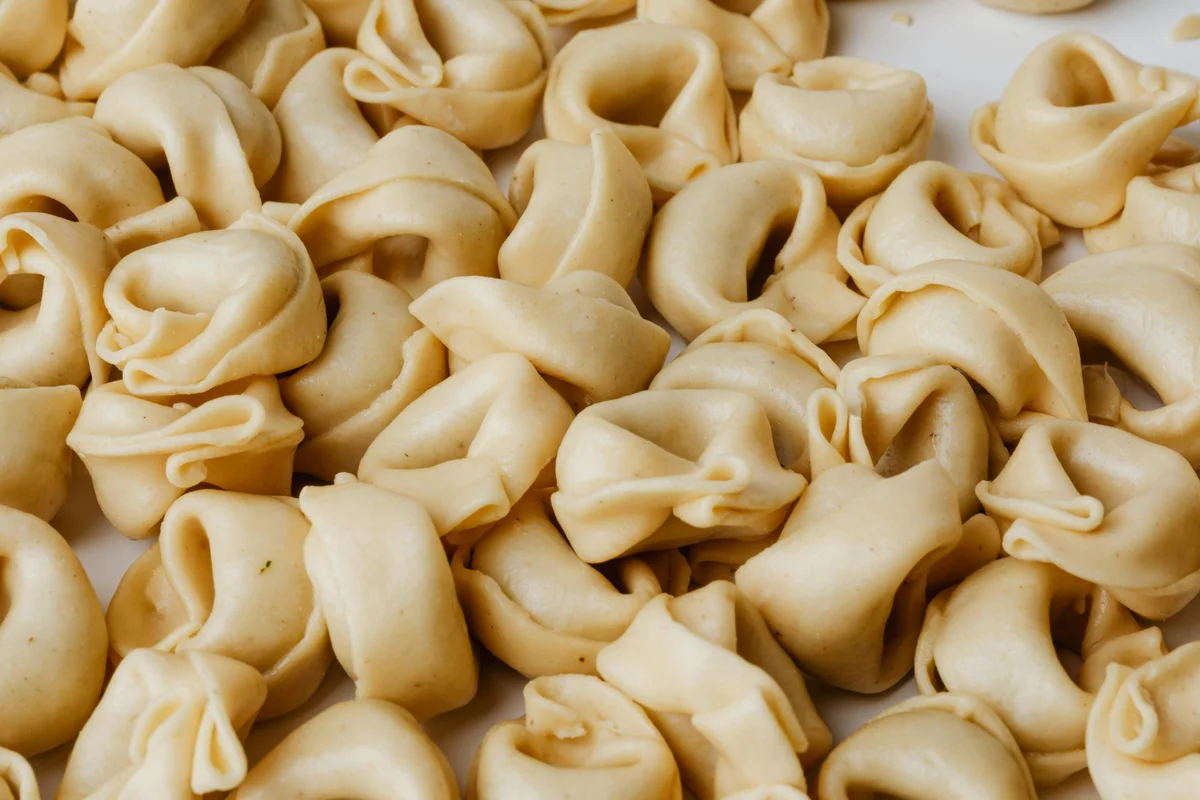
The Dense, Bite-Sized Nugget: Tortellini, cappelletti, wontons. These are small, three-dimensional shapes, often twisted into rings or hats. The interior space is tiny and deep. The filling must be intensely flavorful, paste-like, and absolutely minimal. A pea-sized amount is often enough. Here, the dough-to-filling ratio tips towards the pasta, which is the point. You get several layers of texture: the tender pasta, the dense, potent core of filling, and the umbelico, the little nub where the pasta is twisted, which is the chewiest, doughiest part and, for me, the best bite. This shape is built for broth. The small size and twisted architecture trap bits of liquid in their folds, so each one delivers a micro-sip of soup along with the filling. Using a loose filling here is a disaster; it will leak out and turn your broth cloudy.
The Substantial, Standalone Package: Tortelloni, large pierogi, potstickers. They have a larger, more capacious interior designed for a more substantial, often chunkier filling. Think squash and ricotta, potato and cheese, a coarse pork and cabbage mix. The dough is usually slightly thicker to support the weight and volume. This is where the open system often shines, as these substantial fillings can handle and benefit from sauce integration. The bite is hearty, a main event in itself. You’re not eating a dozen; you’re eating four or five. The pasta shifts from a component of a dish to the center of the plate.
You don’t need it to be thick to make it stick.
Texture as a Landing Strip
Finally, consider the exterior topography. A smooth, flat raviolo and a ridged, concave tortellino interact with sauce in completely different ways.
The smooth surface is a canvas. Sauce will coat it, but it can also slide off. This is where the quality of your pasta’s finish matters, a slightly rough, porous surface, achieved by rolling with a wooden pin or a textured roller, will grab and hold onto sauce better than a slick, machine-extruded one. For smooth shapes, your sauce often needs a bit of body, a velvety butter and sage emulsion, a creamy cheese sauce, a ragù that’s reduced to a clinging consistency.
The textured surface is a trap. The ridges on garganelli (though not filled) are the classic example, but think of the folded layers on a wonton or the pinched pleats of a momo. These nooks and crannies are engineered to capture sauce. They provide textural interest and ensure that every bite is sauced. A thin, brothy sauce works beautifully here because it pools in the architecture; you don’t need it to be thick to make it stick. The shape itself is doing the work.
This is where the “ingredients do the heavy-lifting” philosophy becomes tactile. A culurgiones from Sardinia, with its intricate braided seal resembling a wheat sheaf, isn’t just pretty. That braid creates extra layers of dough at the seam, a chewy contrast to the soft potato-mint-pecorino filling. The shape is the texture. You don’t add crunch on the side; you baked it into the design.
Is it wet or dry? Fine or chunky? Subtle or powerful?
That tells you your seal.
How much of it do you want per bite? Is it a star or a supporting actor?
That tells you your architecture.
What’s accompanying it? A glossy butter sauce or a deep, brothy pool?
That tells you about your surface.
None of this is a constraint. It’s the liberation from random choice. It’s the system that turns the chaos of global dumpling traditions into a coherent, beautiful map. I keep a notebook of shapes I find, not by nationality, but by these structural categories. A Georgian khinkali and a Chinese soup dumpling are neighbors in the “fortified closed system with broth interior” cluster. It makes sense of the mess.
Last winter, a friend in Riga asked me to help her make tortellini for the first time. She had a beautiful filling of local curd cheese and wild mushrooms. She was nervous about the folding. I told her to forget the “authentic” shape for a second. “Your filling is thick and dry,” I said. “You could leave these as open-ended tortelloni, let the cream sauce flood in. But if you want the broth experience, you need to seal them tight, make them small, and use less filling than you think.” She made tiny, tight rings. When we boiled them in chicken broth, they held. She tasted one, and her eyes widened. “It’s all there,” she said. “The mushroom, the cheese, the soup… it’s all in one bite.” That’s the moment. You’re not just making pasta. You’re engineering a specific moment of pleasure, one deliberate, folded corner at a time.