
12 min read · 2,414 words
The jar of bright yellow sludge that lives on most refrigerator doors, untouched except for July barbecues, this is not mustard. This is, bon, nostalgia in a plastic squeeze bottle. And I don’t say that to be cruel; I say it because last week, my neighbor Trev, not my husband Trevante, different Trev: watched me pull four mustards from my fridge to build a single vinaigrette and asked, with genuine concern, whether I was “okay financially.” As if having options meant I was preparing for scarcity, not flavor.
But here’s what I wanted to tell him while I stood there holding my Edmond Fallot alongside a jar of sharp English stuff and my secret-weapon Chinese hot mustard: you don’t keep multiple mustards because you’re extravagant. You keep them because mustard isn’t one thing. It’s a family of ingredients that share a plant, Brassica juncea, Sinapis alba, depending, but beyond that, they diverge completely. Different seeds, different liquids, different intentions. Treating them interchangeably is like treating fish sauce and soy sauce the same because both are brown and salty. C’est absurde, non?
This is how otherwise excellent cooks limit themselves without knowing it. They keep a single mustard as though mustard were a single thing, like salt or pepper. But salt is fleur de sel and sel gris and Maldon and that grey stuff from Brittany my husband cannot live without. Pepper is white and black and sometimes long pepper if you’re feeling ambitious. And mustard: ah, mustard is perhaps the most misunderstood condiment in the American kitchen precisely because it appears everywhere but reveals itself almost nowhere.
What We Ask Mustard to Do
The problem begins with expectation. People want one mustard to perform as acid, as fat, as heat, as emulsifier, as background hum and foreground shout simultaneously. They want it to cut through a vinaigrette, stand up to sausage, tenderize a lamb chop, and also spread gently onto a child’s sandwich without complaint.
C’est impossible, obviously.
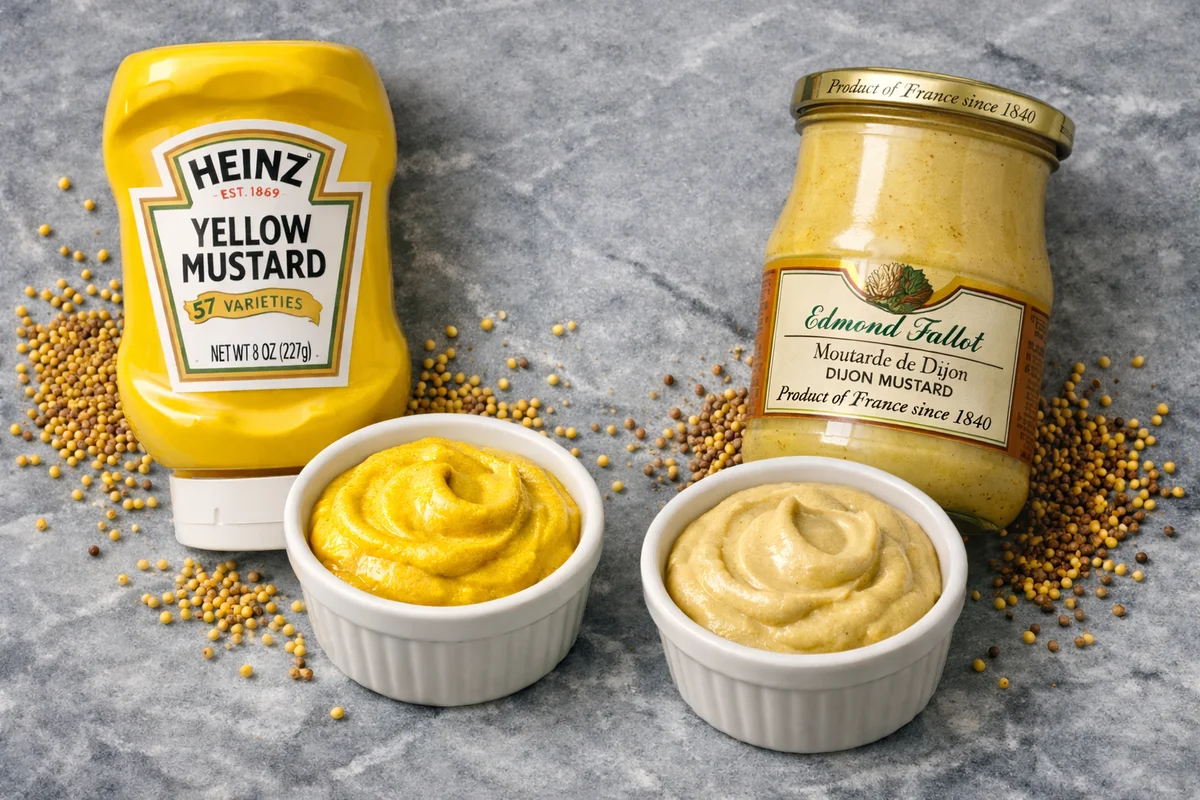
Yellow mustard, that bright, mild, turmeric-touched American standard, does exactly what it was designed to do. It provides gentle acidity and that particular sunny color without challenging anyone. It contains no wine, comparatively little heat, and enough sugar to remain approachable. For hot dogs, for potato salad, for small humans who have not yet developed complex palates, it is perfectly appropriate. My nephew in Berlin will eat nothing else. I do not fight this battle.
But if you reach for that same bottle when making sauce gribiche, when glazing a ham, when building a vinaigrette for bitter greens: you are asking a delicate instrument to perform like a blunt tool. It will not rise to the occasion. It will simply disappoint you, and you will blame yourself, or worse, you will decide you do not like mustard.
Dijon
When people tell me they do not like Dijon, I ask them which Dijon. They look at me as though I have asked which water. This is understandable, eh. The category has become generic in ways that obscure its actual character.
True Dijon mustard contains no turmeric, no sugar, no stabilizers beyond the natural emulsifying properties of the seed itself. It is simply brown or black mustard seeds, verjuice or white wine, salt, and acid. That is all. What you taste, that sharp, clean heat that dissipates quickly rather than lingering aggressively, is the mustard seed expressing itself directly.
When I trained in French kitchens, Dijon was treated with the reverence usually reserved for religious artifacts. Fallot, based in Burgundy, is the last independent mill producing traditional Dijon mustard in the region. Fallot, in my experience, maintains the traditional methods better than most. The moutarderie still grinds seeds between millstones, still ages the paste in oak barrels. You can taste the patience in the result: there is no shortcut in that process, and there is no shortcut in the flavor. When someone tells me they don’t like mustard, I suspect they have only tasted the hurried versions, the ones that shout without saying anything.
But Dijon also loves center stage. A dollop whisked into pan juices after searing pork chops creates an instant sauce that tastes like you planned it for hours. Mixed with crème fraîche and herbs, it becomes the sauce for poulet rôti that makes people close their eyes when they taste it. The heat cuts through fat; the wine base adds depth that vinegar-based mustards cannot achieve.
You don’t keep multiple mustards because you’re extravagant. You keep them because mustard isn’t one thing.
Whole Grain
The first time I understood whole-grain mustard’s proper role, I was working in a bistro in Lyon. The chef served a simple saucisson sec with nothing but whole-grain mustard and cornichons. The sausage was excellent, but the mustard made it memorable: each bite carried the crunch of seeds releasing their heat in bursts, like tiny flavor fireworks. The irregular texture forced me to pay attention to what I was eating. I could not sleepwalk through that meal.
Whole-grain mustard contains the same seeds as smooth varieties, but they are soaked, crushed partially, then mixed with a thinner base. The result is less emulsion, more suspension. This matters for certain applications. Spread on a ham sandwich, it provides textural contrast that smooth mustard cannot achieve. Whisked into a sauce, it creates visual interest and sudden pockets of intensity. I use it in potato salads where I want the dressing to coat but also to surprise, in vinaigrettes for sturdy greens like kale or endive that can handle the aggression.
I use whole grain mustard when I want a sauce to have architecture. A simple pan sauce for pork, deglaze with white wine, mount with butter, becomes something else entirely when you stir in a spoonful of whole grain mustard off heat. The seeds suspend in the emulsion like tiny flavor reservoirs. Each one contributes its moment of heat separately, so the sauce tastes alive throughout eating, not just at first bite.
German Mustards
My husband Trevante spent four years in Berlin before we met. He tells people he learned to tolerate mustard there, which is his way of saying he learned to love it without admitting sentimentality. But I know what actually happened: he discovered that mustard could be aggressive without apology, and this suited him.
German mustards, particularly the varieties from Bavaria and the Rheinland, pursue heat differently than French mustards. Where Dijon aims for precision, German mustards aim for presence. They often incorporate horseradish, which extends and intensifies the sensation of heat without changing the mustard’s fundamental character. They use darker seeds, sometimes incompletely husked, which contributes a bitterness that French producers typically avoid. They do not worry about whether you find them subtle, because subtlety is not the objective.
I keep a jar of Bavarian sweet mustard, süßer Senf, specifically for Weisswurst, which I make perhaps twice a year when I am homesick for Munich restaurants where I worked briefly in my twenties. This mustard is barely mustard at all, in the French sense. It is coarse, almost syrupy, sweetened with caramelized sugar or apple puree, so mild that children can eat it by the spoonful. It exists in complete opposition to everything I learned in French kitchens. I adore it.
This is what I mean when I say mustard cannot be reduced to a single expression. The Bavarian version is not a failed attempt at Dijon. It is a successful attempt at something else entirely: something designed to complement veal sausages and pretzels and wheat beer, none of which require sharp acidity or aggressive heat. It provides sweetness and texture and a gentle mustard whisper that reminds you what the base ingredient is without insisting on the point.
Yellow Mustard
Bon, I know what you expect me to say here. That yellow mustard is worthless, that it’s for children and hot dogs, that I would never touch the stuff. But this is where I disappoint you, perhaps. Because I keep French’s in my fridge, and I am not ashamed.
Here is what yellow mustard understands that fancy mustards sometimes forget: context matters more than purity. A hot dog at a baseball game in August, eaten while standing, while distracted, while happy: this is not the moment for Dijon’s subtlety. The sharp, uncomplicated tang of yellow mustard cuts through the fat of the sausage and the sweetness of the bun without demanding your attention. It is background music done correctly, the kind that improves the scene without becoming the scene.
My husband, Trevante, who grew up here in California, reaches for the yellow bottle when he makes his grandmother’s deviled eggs. The recipe specifies it, and the recipe is correct: not because yellow mustard is objectively better, but because that specific tang belongs to that specific memory. To substitute Dijon would be to change the story. Sometimes faithfulness matters more than improvement.
The decision: use yellow mustard when you want nostalgia as ingredient. When you are making barbecue sauce and you want that specific American diner quality. When you are frying fish and the cornmeal coating needs a sharp, wet binder. When you are, yes, eating a hot dog at a baseball game and the mustard should taste exactly like every other hot dog you have ever eaten at a baseball game. There is culinary value in consistency, in shared reference points.
The question is not “is this mustard good?” The question is “good for what?”
Chinese Hot Mustard
The first time I tasted proper Chinese hot mustard, I was in Berlin of all places, at a dim sum restaurant near Alexanderplatz run by a family from Guangdong. They served it with dumplings, that fluorescent yellow paste that looks innocent until it enters your sinuses with the force of a chemical weapon. I coughed. My eyes watered. And then I understood: this was mustard operating on entirely different principles.
Chinese hot mustard is made from brown mustard seeds ground dry, then hydrated just before serving with cold water. The critical difference is timing: the enzymatic reaction that produces allyl isothiocyanate, the compound responsible for mustard’s heat, peaks within minutes of mixing and then degrades rapidly. This is why the prepared mustard in packets or jars loses its potency; the chemistry has already happened and dissipated.
The heat profile is completely distinct from Dijon’s architectural sharpness. Where European mustards attack the tongue, Chinese hot mustard assaults the nasal passages. It is volatile, aggressive, almost violent in its immediacy. And yet, paired with fatty pork dumplings or crispy egg rolls, it performs essential work: the heat cuts through grease while the volatility clears your palate between bites, resetting your ability to taste.
English Mustard
English Mustard: The Argument for Pain
I don’t want to suffer. I want to feel. And English mustard, Colman’s specifically, is feeling. It is not complex; it is not subtle; it arrives in your sinuses like an urgent telegram. There is no vinegar to soften it, no wine to complicate it. Just mustard powder and turmeric and flour, waiting for water to wake it up.
The decision: fresh English mustard is for when you need to cut through something impossibly rich. A fatty roast beef, a mature cheddar, a pork pie that threatens to coat your entire mouth in suet. The heat clears everything, resets your palate so you can take another bite. It is not meant to be lingered over. It is meant to shock.
I use it maybe six times a year. This is enough. Some nights, when I have a stuffy nose, I stand at my counter and make a tiny amount in a ceramic ramekin, just to smell it. The ritual matters, too: stirring the yellow-green powder into a smooth paste, watching it transform from dry to dangerous. Waiting those ten minutes, impatient, knowing what’s coming. Works better than menthol.
What Your Fridge Actually Needs
So here is what I told Trev, my neighbor, standing in my kitchen with four open mustards on the counter: you do not need all of these. But you need more than one. Because the question is not “is this mustard good?” The question is “good for what?” I cannot tell you exactly which mustards to buy, because your cooking is not my cooking and your palate is not my palate. But I can tell you what functions require different tools.
Then you need one mustard that provides texture. This can be whole grain Dijon, or it can be a coarse German variety, or it can be a spicy brown deli mustard with visible seed fragments. The specific choice matters less than the presence of intact or partially intact seeds that release heat progressively rather than immediately.
You need one mustard that pleases you personally in ways that resist explanation. For me, this is the Polish mustard with horseradish that my friend Polina sent me from Kraków before she passed. It is too aggressive for vinaigrettes and too coarse for sauces and I eat it directly from the jar with cured fish when no one is watching. You should have something equivalent, like yellow mustard for nostalgia, for the taste of summers you didn’t know you were still carrying.
I don’t keep multiple mustards because I’m preparing for every possible scenario. I keep them because each one represents a different way of paying attention. Dijon pays attention to structure. Whole grain pays attention to moments. Yellow pays attention to memory. English pays attention to sensation. And my mother, grinding mustard seeds in Abidjan thirty years ago, was paying attention to something I’m still trying to understand.
The jar of bright yellow sludge is fine for July barbecues. But July is only one month. The rest of the year, you deserve mustard that knows your name.